Tuesday, March 8, 2016

Amendment(draft) of ‘Public notice on Investigation of Harmfulness and Hazardousness of New Chemicals’

On February 19, Korea MoEL(Ministry of Employment and Labour) has announced Public Notice No. 2016-68 ; Amendment(draft) of ‘Public notice on Investigation of Harmfulness and Hazardousness of New Chemicals’
For main revision, please see the details below.

■ Adoption of the definition of ‘Polymer compounds’(Article 2)
: To define term of  ‘polymer compounds’ in accordance with standards of Organization for Economic Cooperation and Development(OCED), etc.

Ÿ   a substance consisting of molecules characterized by the sequence of one or more types of monomer units.
Ÿ   Such molecules must be distributed over a range of molecular weights wherein differences in the molecular weight are primarily attributable to differences in the number of monomer units.
Ÿ   Over 50 percent of the weight for that substance consists of polymer molecules that contains a sequence of at least 3 monomer units, which are covalently bound to at least one other monomer unit or other reactant.
Ÿ   The amount of polymer molecules presenting the same molecular weight must be less than 50 weight percent of the substance.

■ Revision on the criteria as ‘Polymer compounds of low concern’ to be exempted from Examination on Harmfulness and Hazardousness (Article 4-3)
: KOSHA has changed the standard for polymer compounds of low concern which to be exempted from examination on harmfulness and hazardousness to combine the international standards and other laws by reflecting the standards of Organization for Economic Cooperation and Development(OCED).

[Article 4-3] Polymer compounds subject to exemption from Examination on Harmfulness and Hazardousness.

1.      Polymer compounds, whose monomers are not new chemicals, and which satisfy one of the following two conditions
a.     Polymer compounds with Number Average Molecular Weight(NAMW) greater than 10,000 whose molecular species with below MW1,000 are present at 5% or less, and species with below MW500 are present at 2% or less
b.    Polymer compounds with NAMW between 1,000 and 10,000 whose molecular species with below MW1,000 are present at 25% or less, and species with below MW500 are present at 10% or less
c.     The polymer consists of 2%(w/w) or more of monomer is not new chemical substance
2.      Exceptions
a.     Cationic polymer compounds (excluding polymer compounds only used in solid form and does not dissolved or dispersed in water
b.    Polymer compounds with ‘less than Mn 10,000’, as monomers exceeding 2%weight and satisfying one of the following conditions
i) New chemicals
ii) Prohibition listed in Occupational Safety Health Act(OSHA)
iii) Authorization subject listed in OSHA
iv) Administration subject listed under OSHA Regulation

■ Set of Specific Conditions of exemption from submission of the test reports (Article 4-2)
: In case where you cannot get test results from the testing including physico-chemical property tests, and if the substance satisfying the conditions of exemption from submission of the test reports, it is available to omit the submission of test reports.


[Article 4-2] Polymer compounds, satisfied with all requirements below, can omit submission of the study report required under Korea OSHA Enforcement Asterisk 11-4-2.
a. Polymer compounds are stable in the stability study in acidic and alkaline conditions.
b. Polymer compounds meet Article 4-3-1-a or 4-3-1-b, and residual concentration of its monomer which subject to Article 4-3-2-b is less than 0.1%.
c. Polymer compounds don’t correspond with Article 4-3-2-a.

Wednesday, July 1, 2015

At last, today the list of existing chemical substances subject to registration defined by K-REACH has just been officially announced by Korea MoE.
The total 510 existing chemical substances are listed, most of which are not very different from draft version, which had been published in October 2014.
According to K-REACH, such substances should be complied with registration within three-year grace period, if those are imported over 1 ton per year.

Please get to the liked and find the attached list, in order to confirm if your chemical substances are on the list.
Also please be noted that hydrates of the listed chemical substances also should be registered.

If any question, feel free to contact us.


http://www.chemnavi.or.kr/spkreach/archives.asp?b_name=v_data&mode=read&IDX=4728&Page=1&Search_Type=&Search_Value=&Category=3&Parent=&Cate=&Search_Cate=&menu=&top_menu_num=&Order_Name=Ref&Order_Type=Desc

Sunday, April 19, 2015

[Polymer] Registration of Polymer under K-REACH

A new polymer which does not satisfy polymer exemption conditions under K-REACH shall be registered like new substance. However, required test data for a polymer are less than those for a substance. Please refer to the following table for data requirements in accordance with tonnage bands.
Volume of
manufacture and import
Data requirements
① 0.1 ~ 1ton/yr
- Physicochemical properties (state of substance, water solubility, melting/freezing point, boiling point, vapor pressure)
- GPC data
- Stability in acidic and alkaline conditions
② 1 ~ 10ton/yr
③ 10 ~ 100ton/yr
- Data requirements of ①, ②
- Acute oral toxicity (Acute inhalation toxicity shall be needed in case the main exposure pathway is considered as inhalation)
- Ames test
- Acute fish toxicity
- Ready biodegradability
④ 100 ~ 1000ton/yr
- Data requirements of ③
- Physicochemical properties (octanol/water partition coefficient, density, granulometry)
- Skin irritation/corrosiveness
- Skin sensitization
- Acute daphnia toxicity
⑤ Over 1000ton/yr
- Data requirements of ④
- Physicochemical properties (flammability, explosive properties, oxidizing properties)
- Acute dermal toxicity or acute inhalation toxicity
- Eye irritation/corrosiveness
- In vitro chromosome aberration using mammalian culture cell
- Genetic toxicity
- 28days repeated dose toxicity
- Reproductive and developmental toxicity: screening
* can be substituted with test protocol
- Freshwater algae growth inhibition
- pH hydrolysis

* Polymer compounds with 1,000≤Mn<10,000 whose monomers, which are new chemicals, hazardous chemicals and chemicals with hazard and risk or announced by MoE, exceed 2%weight shall be registered, but if content of residual monomer is less than 0.1%, only physicochemical test data are required.

Thursday, April 9, 2015

It is likely ; Deregulation in the required data for KOSHA registration.

▪ With regards to KOSHA registration with tonnage band of ‘over 0.1t/y’, the hazard studies which required to submit would be reduced from three(3) end points at present to one(1) end point.

 For the substance registration under KOSHA, it is required in principle to submit the 3 end points of toxicity(acute toxicity test-oral / inhalation, Ames test, and micronucleus test), even though micronucleus test is usually waived. But Korea Ministry of Employment and Labor(MoEL) has a plan to substitute those requirement with only the acute toxicity test. Also other genotoxicity studies like Ames test, micronucleus test could be ordered to submit by MoEL for the chemical substance that is expected to cause harmful risk to the health like mutagenicity.

▪ In addition, MoEL has a plan to shorten the duration for examination of registration dossier with tonnage band of ‘over 0.1t/y’ from 45 days at present to 14 days, i.e. MoEL will respond to each application of substance registration within 14 days.

▪ Expected schedule by MoEL
- 2015.4 : Preparation for amendment of the enforcement rule
- 2015.5 : Legislative notice
- 2015.7 : Review for regulatory and legislative purpose

- 2015.9 : Enactment and enforcement.

Registration of new chemical substance ; K-REACH vs KOSHA

▪ For the new chemical substance, which is defined as not-listed substance onto Korea Inventory of Existing Chemical Substance, it should comply with registration under both K-REACH and KOSHA, since K-REACH has come into enforcement as of January 1 2015.

▪ With the tonnage band of ‘over 1t/y’ before beginning of 2020, the dossier for K-REACH registration can be also submitted to MoEL for KOSHA registration without further hazard data development.

▪ However, be noted that there is conflict in the required hazard data for registration between K-REACH and KOSHA, only regarding registration with tonnage band of ‘0.1 to 1t/y’

▪ please refer to the comparison in the table for the details
Before 2020
K-REACH (MoE)
KOSHA (MoEL)
Tonnage
< 0.1t/y
01t/y~1t/y
< 0.1t/y
0.1t/y <
Required
Data
Basic Information Only
“No Hazard Data”
Exempted from registration
Basic Information
+
“Hazard Data1” Required

▪ Unlike K-REACH, because KOSHA does not have the legal definition of ‘Representative’(similar concept to Only Representative in EU REACH), the registration under KOSHA should be conducted by the name of Korea importer. Nevertheless KOSHA registration could be completed via the authorized 3rd Party by the overseas manufacturer, without risk to disclose the worthy information of the substance(CBI) to Korea importers. 

How to register intermediates under K-REACH

▪ Intermediate means a substance that is manufactured for and consumed in or used for chemical processing in order to be transformed into another substance.
-          Non-isolated intermediate : an intermediate that is not intentionally removed from the equipment in which the synthesis takes place, during synthesis.
-          Isolated intermediate : other intermediate that is not falling in definition of Non-isolated intermediate.

▪ K-REACH compliance subject to Non-isolated intermediate
-          Exempted from the obligation of ‘Annual Reporting’
-          Exempted from the obligation of ‘Registration’, but prior confirmation of the registration exemption shall be required (just once at first time)

▪ K-REACH compliance subject to Isolated intermediate
-          Only “isolated intermediate which blocked from release or exposure by functional method” can be exempted from the obligation of ‘Registration’ but prior confirmation of the registration exemption shall be required (just once at first time)
-          Other isolated intermediates are subject to Registration. But, the submission of hazard data,  risk and exposure assessment, or safe use guidance could be exempted.


▪ According to consultation with the competent Korea Government, the authority is most likely to only consider ‘On-site, Isolated intermediate’ as ‘Isolated intermediate’ which defined under K-REACH. This means that in adverse ‘Transport, Isolated intermediate’ is considered as ‘Substance’. Therefore ‘Isolated intermediate’ imported into Korea should comply with K-REACH obligation as ‘Substance’, not as ‘Isolated intermediate’, even though the same substance is considered as ‘Isolated intermediate’ in the relevant regulations of other countries, like EU-REACH.

[Polymer] Comparison of Polymer Exemption Conditions between K-REACH and KOSHA

There are considerable differences in polymer exemption conditions between K-REACH and KOSHA. Therefore, if business entity intends to get confirmation of polymer exemption, they should consider exemption conditions of both K-REACH and KOSHA. If a new polymer satisfies exemption conditions under K-REACH but does not satisfy those under KOSHA, and vice versa, business entity should proceed registration or apply for confirmation of exemption from registration under K-REACH and KOSHA respectively. However, if a new polymer satisfies exemption conditions under both K-REACH and KOSHA, business entity has only to apply for confirmation of exemption from registration under K-REACH, which covers counterpart under KOSHA. Please refer to the following table for details.

K-REACH
KOSHA
Ø  Polymer compounds with Mn≥10,000 whose molecular content of MW<1,000 is less than 5% and that of MW<500 is less than 2%
Ø  Polymer compounds with 1,000≤Mn<10,000 whose molecular content of MW<1,000 is less than 25% and that of MW<500 is less than 10% (Exception: polymer compounds whose monomers, which are new chemicals, hazardous chemicals and chemicals with hazard and risk or announced by MoE, exceed 2%weight)
Ø  Exception: Cationic polymer compounds (excluding polymer compounds only used in solid form and not dissolved or dispersed in water)
Ø  Polymer compounds, whose Mn≥1,000, which  do not make cation, whose monomers are neither new chemicals, prohibited substances, substances subject to permission nor hazardous substances subject to control and which satisfy one of the following two conditions
-       If insoluble in water or organic solvent, polymer compounds should not contain any metal, except sodium, magnesium, potassium or calcium
-       If soluble in water or organic solvent, molecular content of MW<1,000 in polymer compounds should be less than 1%. If polymer compounds’ Mn<10,000, the monomers should not include double bond between carbons, triple bond between carbons, double bond between carbon and nitrogen, triple bond between carbon and nitrogen, aziridine group, epoxy group, sulfonic acid group, hydrazine group, phenolic hydroxyl group, or fluorine group

Wednesday, January 22, 2014

MoE opened K-REACH HELPDESK homepage

 To support domestic and foreign industry associations with procedures of K-REACH, the Ministry of Environment has opened K-REACH HELPDESK homepage.

The Helpdesk will provide relevant information such as the following:

 - Provision and promotion of K-REACH-related data and training
 - Counseling regarding K-REACH implementation
 - Collect opinions of K-REACH related persons


 If you have any question about regulations in Korea, please feel free to post your question or send an e-mail to ehcho@namandnam.com. Thank you.

Sunday, January 5, 2014

What is the standard in the Korea MSDS(GHS classification) ?

 Korean GHS classification could be difficult because it is regulated by two laws.
Below are the answers to your questions: 


※ If the toxic chemical or the product is contains toxic chemical, then you have to comply with TCCA secondary public notification – NIER Public Notice No, 2013-24, If not, please classify according to the OSHA secondary public notification – MoEL public notification No. 2013-37.

 For more information on regulations in Korea, please feel free to post your question or send an e-mail to ehcho@namandnam.com. Thank you.

CBI under TCCA

  If data submitted for toxicity examination is technically or commercially sensitive of a company and can cause disadvantage should the information be disclosed to a third party, the applicant can submit an application for confidential protection.

  However without application for confidentiality, the National Institute of Environmental Research (NIER) has a general principle of keeping all information obtained from Toxicity Examination of New Chemicals confidential to a third party. Therefore only chemical names and CAS numbers are announced in the official gazette and any other information is unlikely to be disclosed to the general public.

  The application for confidential protection must be filed together with an application for notification, and the following documents are required to be submitted.
   - An application for confidentiality protection
   - A statement of reasons for confidentiality protection
   - Data for confidentiality protection

  Unless there is a specific reason, confidentiality protection is valid for 5 years. If a notifier applies for an extension one month prior to the expiry date, confidentiality protection can be extended twice, each time for a further 5 years (maximum of 15 years in total).

  For more information on regulations in Korea, please feel free to post your question or send an e-mail to ehcho@namandnam.com. Thank you.

Thursday, December 19, 2013

K-REACH Public Hearing

On 27 December 2013, a public hearing will be held on K-REACH. Drafts of lower statutes are expected to be introduced on the same day as the hearing. We will provide more detailed information on K-REACH following the public hearing. If you have any questions, please feel free to contact me at any time. Thank you.

Thursday, November 28, 2013

Expected Effectiveness for Introduction of K-REACH

  K-REACH is a law to fulfill the global principle of “No Data, No Market” and public demand for safe use of chemicals. It can be thought of as a Korean version of EU REACH Regulation.
  Currently, the lower statutes are being legislated through gathering opinions of various interested parties, for example from communication and discussion within a conference group comprised of industries including foreign companies, and experts, etc.

  More than 85% among 44,000 species of chemicals in Korea are distributed without hazard information. Since only limited information is available for the other 15%, it would be no exaggeration to say that the impact these chemicals have on human health and the environment is not definite. It is no exaggeration to say that the impacts these chemicals have on human health and the environment are not definitive investigations because the other 15% chemicals were also figured out only restricted hazard information.
  In the future, if existing chemical substances already in circulation meet certain requirements, these substances should be registered under the K-REACH, and should only be used after evaluation of risk assessment concerning use and exposure. Safety standards and indication standards must be prepared and managed by risk assessment of chemical products, especially of the following: household items such as detergents and air fresheners, insect repellents, and biocides including disinfectants.
  With this, all chemical manufacturers, importers, and goods producers will contribute to public health and the protection of the environment by identifying and communicating information on risks and safe use of chemicals.

 For more information on regulations in Korea, please feel free to post your question or send an e-mail to ehcho@namandnam.com. Thank you.

Thursday, November 21, 2013

SIMILARITIES AND DIFFERENCES BETWEEN K-REACH AND EU REACH


 K-REACH which will be implemented from January 1, 2015 in Korea has much in common with EU REACH. Let’s find out similarities and differences between K-REACH and EU REACH.

Similarities
1. Obligor and tonnage levels for registration (Existing substances)
 Obligor and tonnage levels for registration (Existing substances) are very similar in EU REACH and K-REACH. The actors with registration obligations under K-REACH are very similar to EU REACH, especially with the introduction of the concept of local representatives. The registration obligation will apply to local manufacturers and importers, and local representatives. The tonnage level for registration is 1-10 ton per annum, 10-100 ton per annum, 100-1,000 ton per annum, and over 1,000 ton per annum, the same as EU REACH.

2. Authorization system of chemical substances
 K-REACH will implement Authorization System of chemical substances which is not present in the current law - Toxic Chemical Control Act (TCCA). The Authorization system of chemical substances specifies substances subject to authorization, restricted or prohibited substances through the assessment of their uses and exposure. The authorization list is expected to be similar to the authorization list of EU REACH.

Differences
1. Substances subject to registration: registration of new chemical substances in quantities of less than one ton per year.
 The registration scope is generally similar: registration is required for new chemical substances, existing chemical substances and substances intended to be released from articles. However K-REACH requires new chemical substances manufactured∙imported in quantities of less than one ton per year to be registered as well.
 Although normally the existing chemical substances subject to registration as prescribed by the Ministerial Decree will require registration at above one ton per year, these substances may need to be registered at less than one ton per year if the substances are recognized to cause severe damage to human health and the environment. The Minister of Environment will designate and publish such substances through deliberation of the Evaluation Committee. Such existing chemical substances manufactured or imported in quantities of less than one ton per year will then need to be registered.

2. Evaluation criteria
 The testing requirements are differentiated depending on tonnage threshold for substances subject to registration. While there are a maximum of 61 testing requirements in EU, there are a minimum of 11 and maximum of 46 testing requirements in Korea. Therefore it is necessary to check the testing requirements for each tonnage level.

3. Reporting
 Unlike EU REACH, manufacturers•importers•salespersons of all new chemical substances or existing chemical substances in quantities of more than one ton per year have the obligation to report the uses of chemicals and the volume for the uses to the Minister of Environment every year as prescribed by the Ministerial Decree under K-REACH.


 Here we have discussed about the main considerations. But the lower statutes for K-REACH are still being legislated and regular monitoring is necessary. It is important for companies to make comparisons between K-REACH and EU REACH in advance and come up with response plans.


For more information on regulations in Korea, please feel free to post your question or send an e-mail to ehcho@namandnam.com.

Thursday, November 14, 2013

Tips for overseas suppliers preparing for Korea's new chemical regualtion, K-REACH

 With K-REACH coming in effect from January 1, 2015, we have organized some checklists to help non-Community suppliers to be prepared for the new regime.

1. Make early-registration of new chemical substance using Korea’s existing law – the TCCA.
 It is a good opportunity for foreign entities to make registrations for new chemical substances early under the existing law – toxic chemical control act (TCCA) while they still can. The new chemical substances registered under the TCCA will be accepted under the K-REACH.

2. Identify and join consortiums of priority existing chemicals.
 Any person who intends to manufacture ∙ import any designated ∙ published existing chemical substances as prescribed by the Ministerial Decree (Ministry of Environment) at 1 ton or more per year will need to register the substance under K-REACH. Although the list of designated existing chemicals is still under revision, when the list is published, it will be vital for companies to check if their substances are included in the list and make preparations accordingly.

3. Start looking for a local representative to submit registrations under K-REACH.
 It is required for foreign companies to appoint a local representative established in Korea who fulfils the requirement specified by the Ministerial Decree, and may have him perform the following tasks to fulfil the registration obligations of the importers. Tasks include: reporting of import volume and use, registration application, notification, other tasks specified by the Presidential Decree.

4. Prepare cost sharing plans within the supply chain.
 Korean manufacturers and importers, local representatives appointed by a manufacturer, producer established outside Korea have the obligation to register a substance. Since one registration is required per substance in a supply chain, these actors can decide who will submit the registration dossier and prepare cost sharing plans

5. Secure supply chains and make early identifications of registration status within the chains.
 Since only one registration number is required for a substance within a supply chain, companies should check beforehand if the substance has been registered somewhere along the chain.

6. Research alternative substances for authorized∙restricted∙prohibited chemical substances.
 The Minister of Environment can revoke the designation of authorization listed substance that may no longer be used as an alternative substance or new technology is developed to substitute the authorization listed substance following deliberation of the Evaluation Committee.

For more information on regulations in Korea, please feel free to post your question or send an e-mail to ehcho@namandnam.com. 

Thank you.

Monday, November 4, 2013

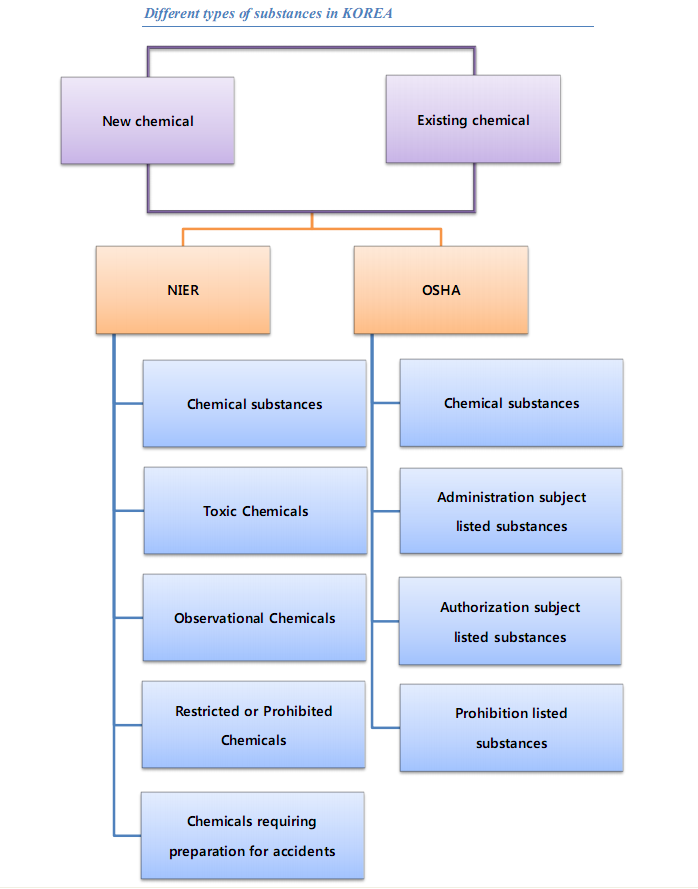
Different types of substances in Korea

 MOE and MOEL have different types of substances. Today we have arranged the types of substances of both institutions.

  In Korea, the two institutions, MOE and MOEL, each divide registered substances into several types through hazard and risk assessment. MOE divides the substances into four types: Toxic chemicals, Observational chemicals, Restricted or Prohibited chemicals, and Chemicals requiring preparation for accidents. MOEL divides them into three types: Administration subject listed substances, Authorization subject listed substances, and Prohibition listed substances. If your substance belongs to the aforementioned types, they will be regulated, and required to go through procedures for reporting (or permission).

 An important issue when proceeding with polymer exemption notification is to check the types of monomers. If your new polymer chemical belongs to Toxic chemicals, you have to proceed with polymer notification under TCCA. If your new polymer chemical belongs to Administration subject listed substances, Authorization subject listed substances, and Prohibition listed substances, you have to proceed with polymer notification under OSHA.


 If you have any question, please feel free to post your question or send an e-mail to ehcho@namandanam.com. Thank you.

Tuesday, October 22, 2013

Arrangement of some terminologies for new chemical substance registration in Korea § Nam and Nam International

 Today we have arranged some terminologies you should know for new chemical substance registration in Korea.


New chemical substance registration is managed by two governmental organizations: Ministry of Environment (MOE), and Ministry of Employment and Labor(MOEL).

Each of them has supporting organizations to support policies: National institute of Environmental Research (NIER), and Korea Occupational Safety and Health Agency (KOSHA). For reference, there is one more supporting organization under the MOE: Korean Chemical Management Association (KCMA).

 New chemical substances are regulated under the Toxic Chemicals Control Act (TCCA) by the ‘MOE’, and the Occupational Safety and Health Act (OSHA) by the ‘KOSHA’.

You can search for existing chemical substances in the Korean Existing Chemicals Inventory (KECI), available at National Chemicals Information System (NCIS).

 The following are websites of above-mentioned organizations.
⊙ KCMA: http://www.kcma.or.kr/eng/index.asp

For more information on regulations in Korea, please feel free to post your question or send an e-mail to
ehcho@namandnam.com. 

Thank you.

Sunday, September 22, 2013

Korea Label

Today we post useful information on Korea Label:

1.) If there are more than seven (7) precautionary statements, only up to six (6) statements can be stated on the label (one or more Precautionary, Respond, Storage and Disposal statements each)

2.) Format

3.) Size
A. Label size per capacity of container or package
Capacity of container or package
Size of printing or label
Capacity≥500 l
Equal to or more than 450㎠
200l≤ Capacity <500 l
Equal to or more than 300㎠
50l≤Capacity <200 l
Equal to or more than 180㎠
5l≤Capacity <50 l
Equal to or more than 90㎠
Capacity <5 l
5% or more of surface excluding top and bottom area of package
B. Size of pictogram
a. Size of each pictogram should be at least one-fortieth of the label.
b. The minimum size of pictogram shall not be less than 0.5㎠.


4.) Subjects excepted from use of Korean Label
A. Samples that already has labels in language other than Korean and that are used only in the laboratory for the purpose of R&D and test
B. Final products that are in transit or in storage for exportation

5.) Labels for transport of hazardous chemical or risky chemicals can comply with UN Recommendations on the Transport of Dangerous Goods, Model Regulations

6.) If the unpackaged containers such as drum is indexed according to the UN Recommendations on the Transport of Dangerous Goods, Model Regulations, the label does not need to contain pictograms.

7.) Labels for mixture must explicitly state the poisonous component’s name and the content ratio (It is acceptable to indicate the CAS No. instead of the chemical name of the poisonous component)

K-REACH and TCCA on Record Keeping Responsibility and Penalties

Today we compare Toxic Chemical Control Act and K-REACH on record keeping responsibility and penalties:

1.) Record Keeping Responsibility

According to the Toxic Chemical Control Act (TCCA), one whose application for manufacture/import notification or new chemical registration/exemption notification has been approved is required to keep related documents for five(5) years. K-REACH, one that would be in force in year 2015, requires the notifier/register to keep related records but the duration is not implicitly mentioned. However, we  prospect that the K-REACH may require the same number of years (five years) as TCCA and that more information would be available once enforcement regulations are announced.

2.) Penalties

TCCA levies less than five years of imprisonment or less than fifty million Won (approximately US$46,472.72 according to the September 23 currency) of fine to those who manufactures or imports a chemical without registration or notification. On the other hand, K-REACH levies more than five years or one hundred million Won (approximately US$ 92,945.44 according to the September 23 currency) of fine to those who manufactures or imports a chemical without registration.

Monday, September 9, 2013

Registration and Risk Assessment under Korea REACh (K-REACH)


1.) Public announcements to watch for after the registration under Korea REACH
- A registered chemical’s name and CAS No. is publicly announced; however, only the generic name is announced for chemicals protected as confidential during the term of its protection.
- If a registered chemical is hazardous, such chemical is designated as a toxic chemical.
- Following chemicals and chemicals that are considered risky as a result of the hazard examination and risk assessment are publicly announced as authorization substance and are required to be authorized by the Ministry of Environment before the manufacture or importation. (The public announcement of authorization substance contains information such as chemical name, the use that needs to the authorized prior to the manufacture/importation, and authorization grace period)
① chemical that causes or is concerned to cause cancer, mutation, adverse fertility, or disruption in endocrine system;
② chemical that highly accumulates in human body, animal and in plant and that remains for a long period of time in the environment;
③ chemical that may cause significant risk equal to or greater than that of chemicals that fall under the preceding categories.
- Following chemicals are publicly announced as restricted or prohibited substance
① chemical that is considered to be hazardous as a result of hazard examination and risk assessment;
② chemical recognized as risky by an international organization; 
③ chemical that is prohibited or is restricted from use by the international treaty; and
④ chemical that is revoked from the designation of authorization substance

2.) Risk Assessment
- Ministry of Environment decides whether to conduct risk assessment of a chemical that falls under one of the categories below based on the result of the hazard examination. MoE can also order the registrant of the chemical to submit needed information for risk assessment.
① chemical manufactured or imported in quantity equal to or more than 10 ton per year; 
② chemical deemed necessary for Risk Assessment as a result of the hazard examination.
- Implementation date for risk assessment based on the tonnage band
① January 01 2015 - A chemical manufactured or imported in quantity equal to or more than 100 ton per year
② January 01 2017 - A chemical manufactured or imported in quantity equal to or more than 70 ton per year
③ January 01 2018 - A chemical manufactured or imported in quantity equal to or more than 50 ton per year
④ January 01 2019 - A chemical manufactured or imported in quantity equal to or more than 20 ton per year
⑤ January 01 2020 - A chemical manufactured or imported in quantity equal to or more than 10 ton per year